
Eliminations
Eliminations are the head-to-head half of a competition: archers drawn against each other from the qualification standings, shooting one match at a time until two of them meet for gold.
A league’s eliminations open the moment its qualification is finalized — not the whole competition’s, just that league’s. Until then the Eliminations tab tells you so, and offers nothing to draw. Leagues is where a league is finalized.
This page follows the individual bracket. A league can run club team and mixed team brackets beside it, drawn from the same standings and scored the same way; Team and mixed team events covers those.
The five views
Section titled “The five views”The Eliminations tab is five views behind one row of buttons, and it opens on the first.
- Status — where the whole competition stands: per league and round, whether the targets are ready, being shot or done, with the way into each one beside it. This is the screen to run a finals day from.
- Elimination Brackets — one league’s draw, read as a tree, and the place a bracket is drawn or deleted.
- Score Entry — the day’s worklist: every match of the chosen league, what each one still needs, and the panel it is scored in.
- Shifts and Field of Play — when each round of a bracket is shot, and where on the shooting line it is shot. Both are covered on Field of play.
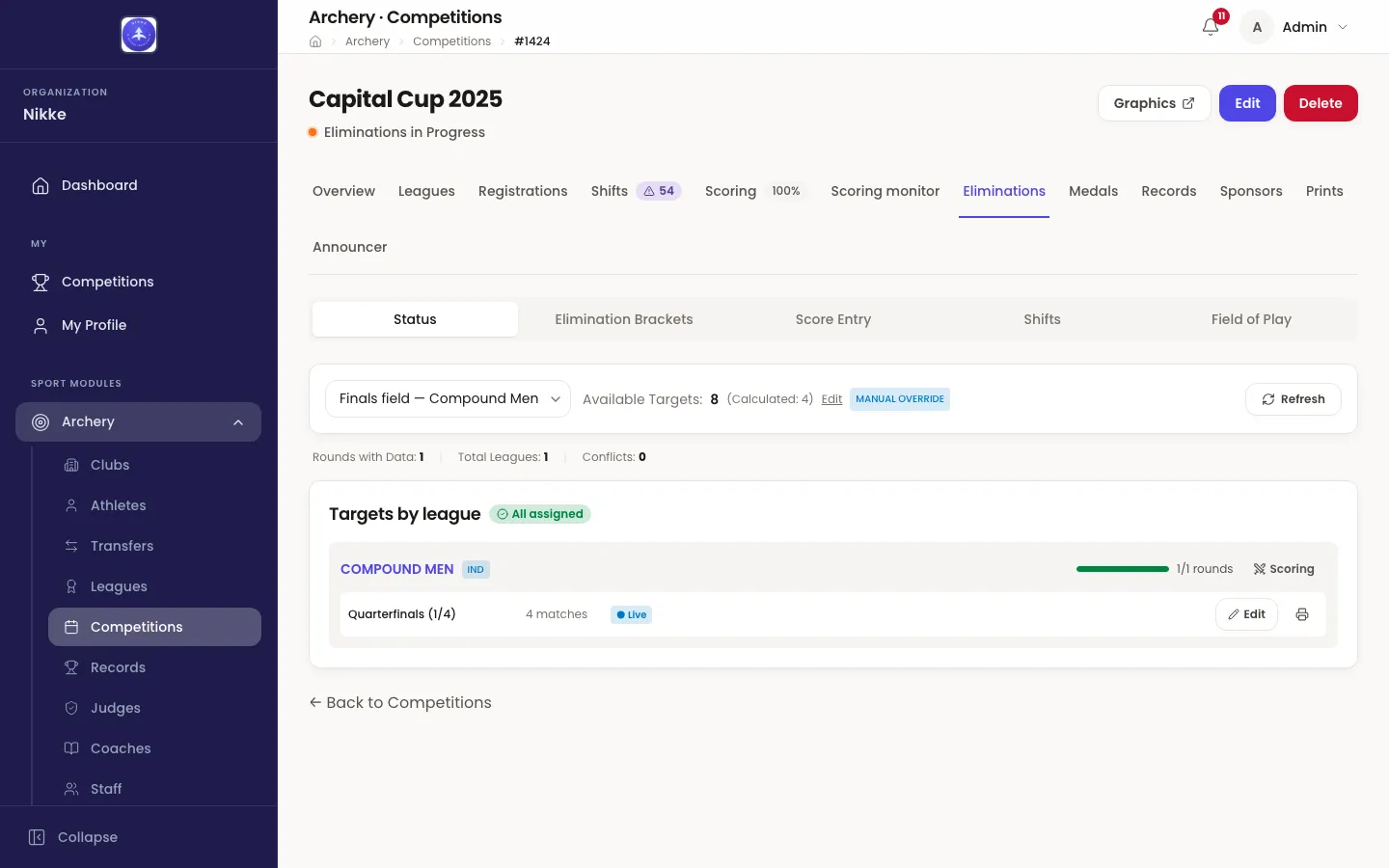
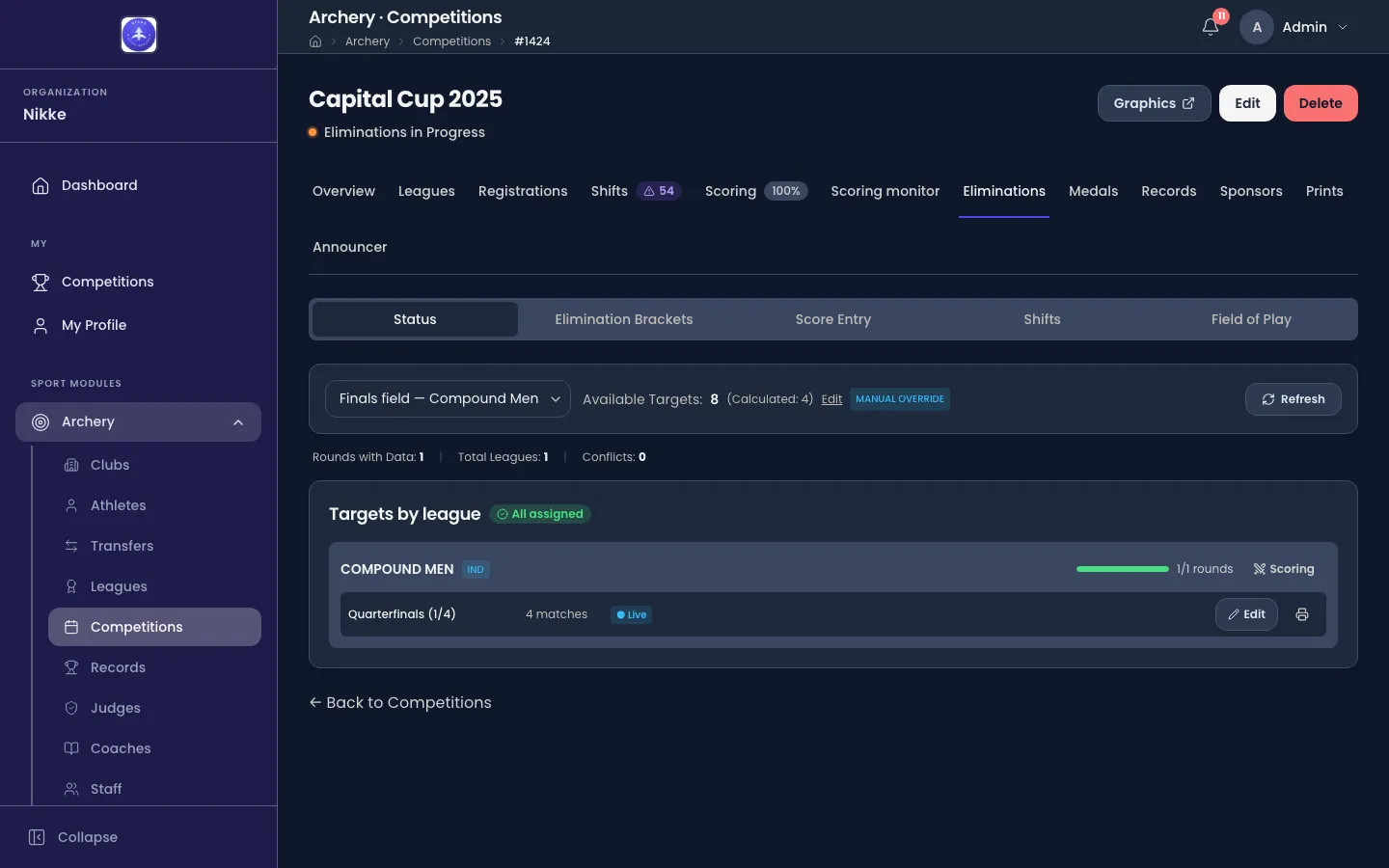
The league and the event you are looking at follow you from view to view, and sit in the address bar while you work — so the page you leave comes back where you left it, and a link to one league’s bracket is a link to that bracket rather than to the tab.
Drawing the bracket
Section titled “Drawing the bracket”Elimination Brackets, then pick the league and whether you are drawing the individual, team or mixed event. Drawing is per league: one league having finalized its qualification is all it takes, and the rest of the competition can still be on the shooting line.
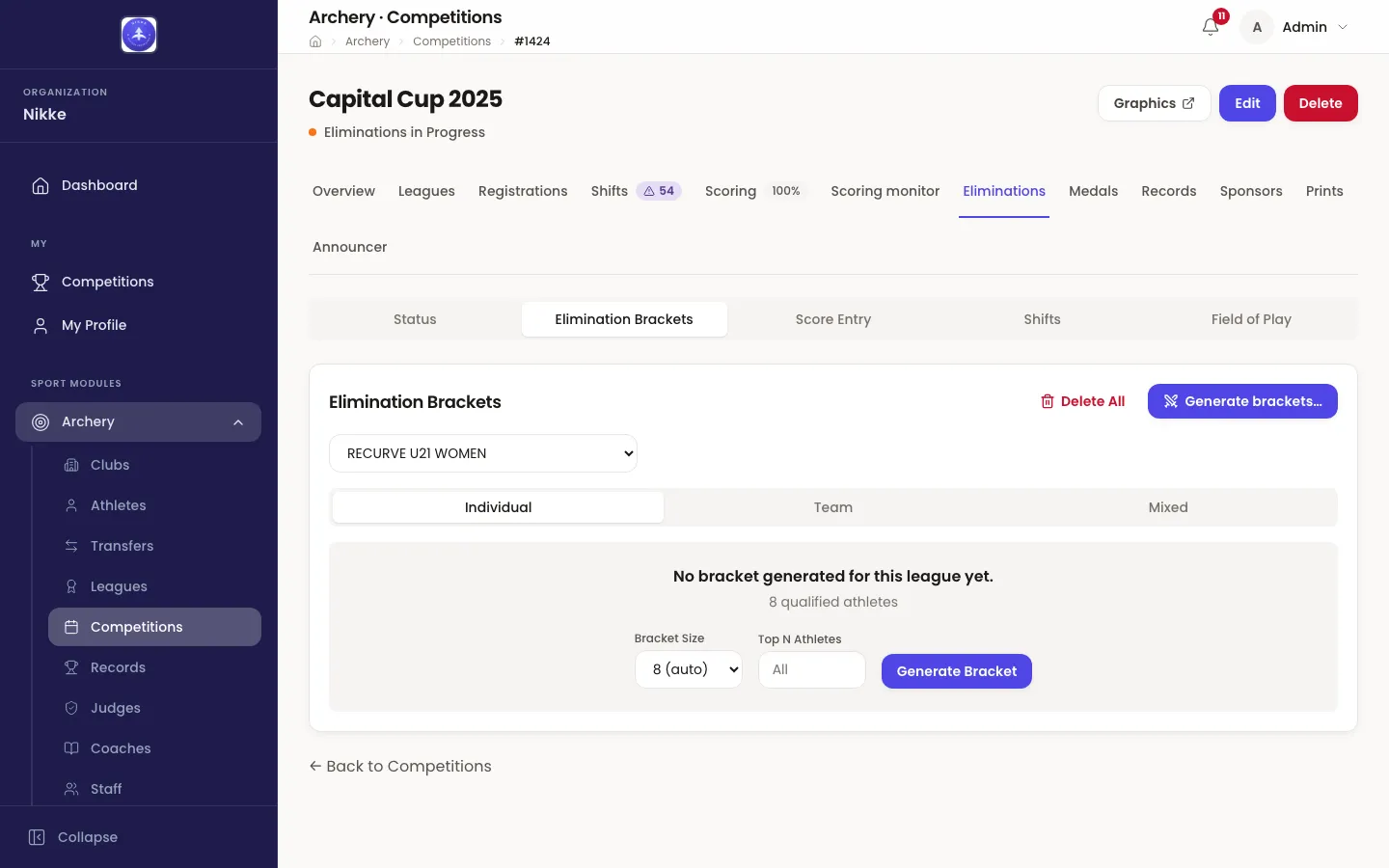
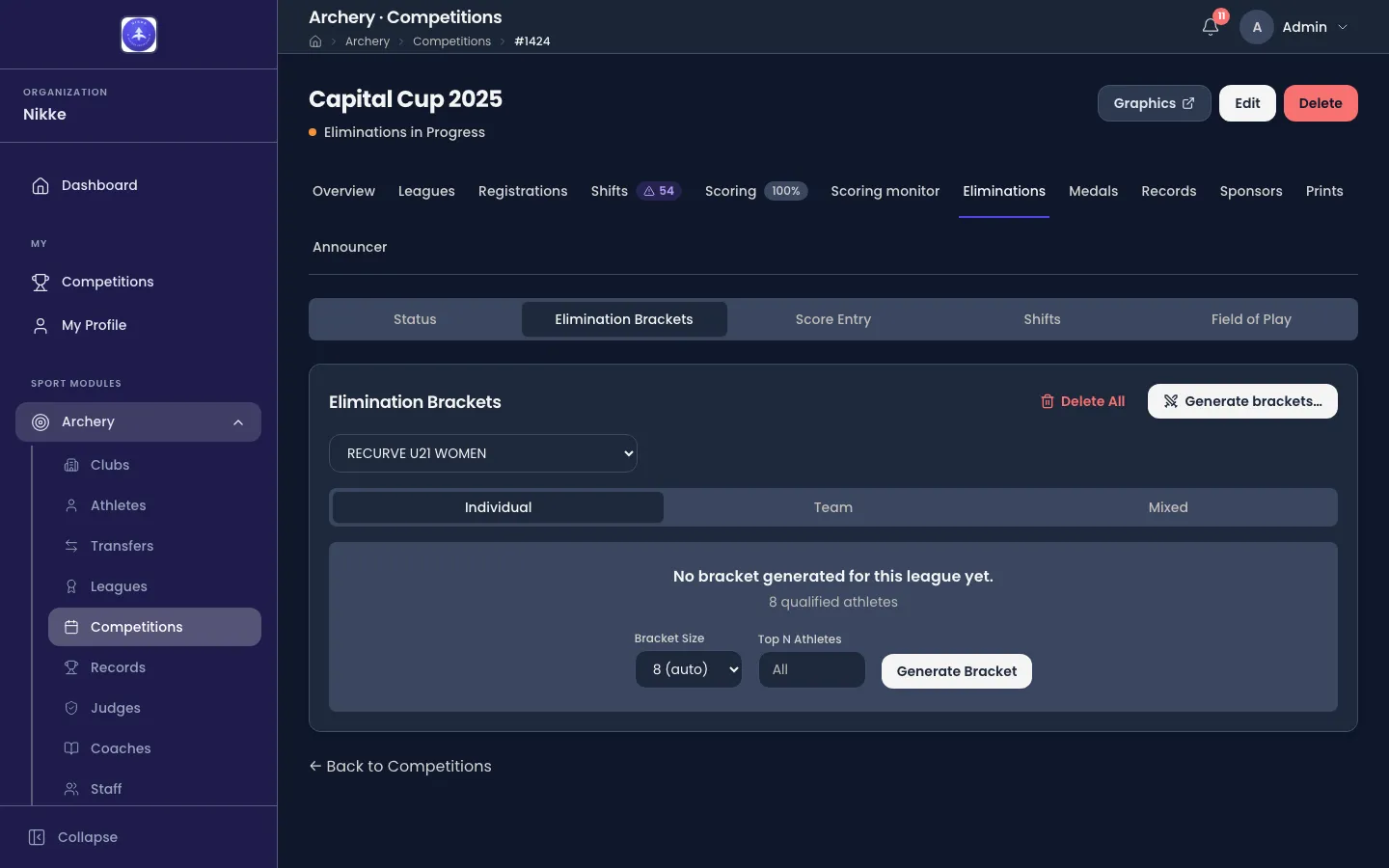
Two settings before you draw:
- Bracket Size — Velos offers the smallest bracket the field fits into, out of 4, 8, 16, 32, 64 and 128, and marks it (auto). Eight qualified archers get a bracket of 8; nine get one of 16. You can choose a larger one; one too small for the field is refused.
- Top N Athletes — the cut. Leave it empty and everyone ranked goes in. Set it to 16 and the top 16 shoot the bracket while the rest finish on their qualification place.
Generate Bracket builds the draw from the final standings.
How the draw comes out
Section titled “How the draw comes out”Seeding follows the World Archery pattern: number 1 at the top of the tree and number 2 at the bottom, 3 and 4 in the halves opposite them, and so on down, so that the two best-placed archers can only meet in the gold match. Each first-round match pairs a seed with the one that completes the bracket — in a bracket of 8 that is 1 v 8, 4 v 5, 3 v 6, 2 v 7.
Where the bracket has more places than there are qualified archers, the empty slots become byes. A bye is not a match anyone shoots: the archer facing one is carried into the next round at the moment the draw is made, and the card says so.
A bronze medal match is drawn for every bracket of three or more. With four or more it is shot between the two beaten semifinalists. With exactly three, the top seed’s semifinal is a bye, so there is only one beaten semifinalist: the moment the other semifinal is decided, the bronze match resolves as a bye for its loser, without arrows, and the bronze is theirs; resetting that semifinal puts the bronze match back to waiting. With two archers there is no third place to award and no bronze match at all — a third place, if the league gives one anyway, is recorded by hand from the Medals tab, as Medals and final standings covers.
Once drawn, the bracket is a tree you read left to right, one column per round, each match carrying its winner into the next. The last two columns are the medal matches in the order they are shot: the bronze medal match first, then the gold.
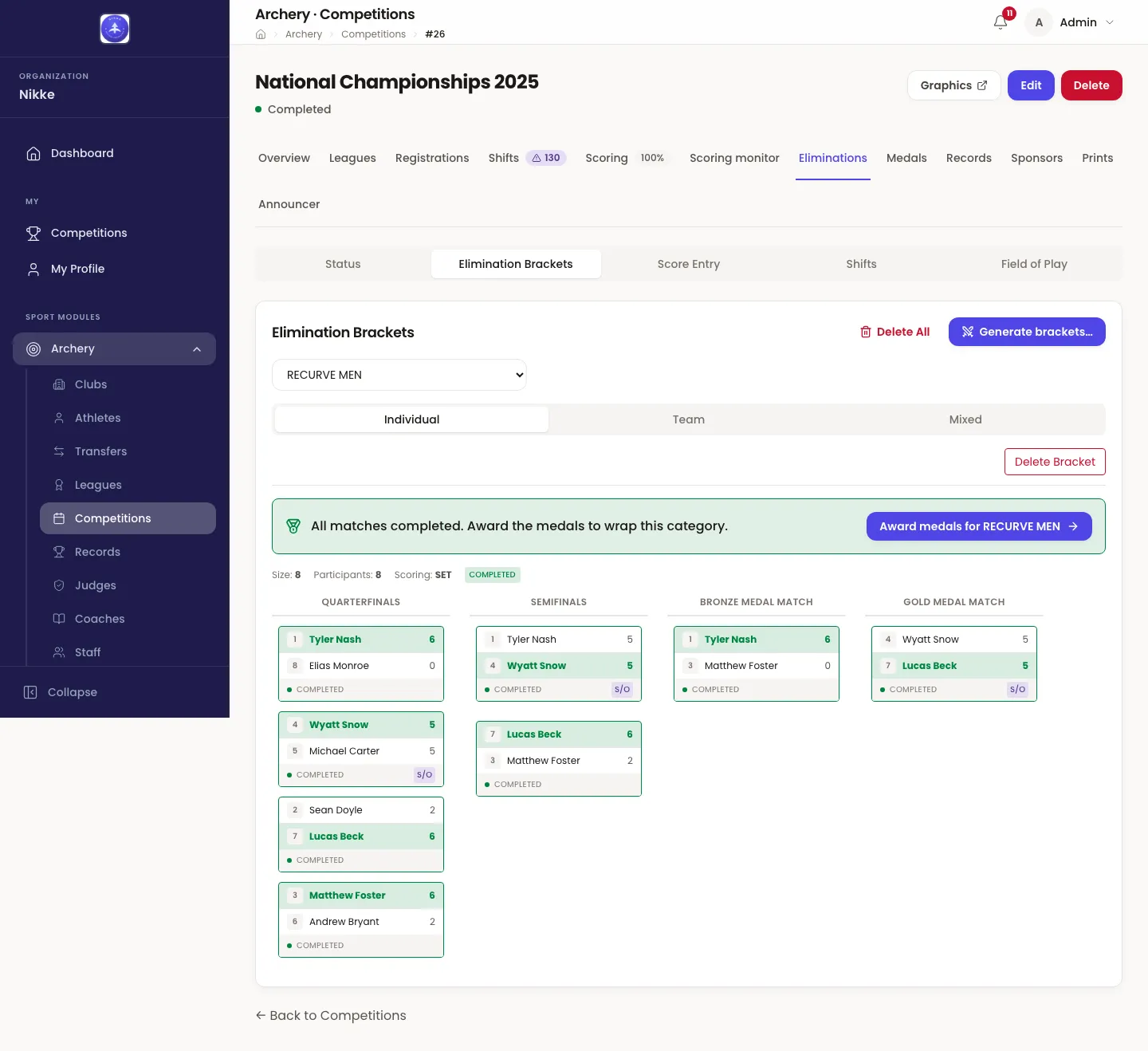
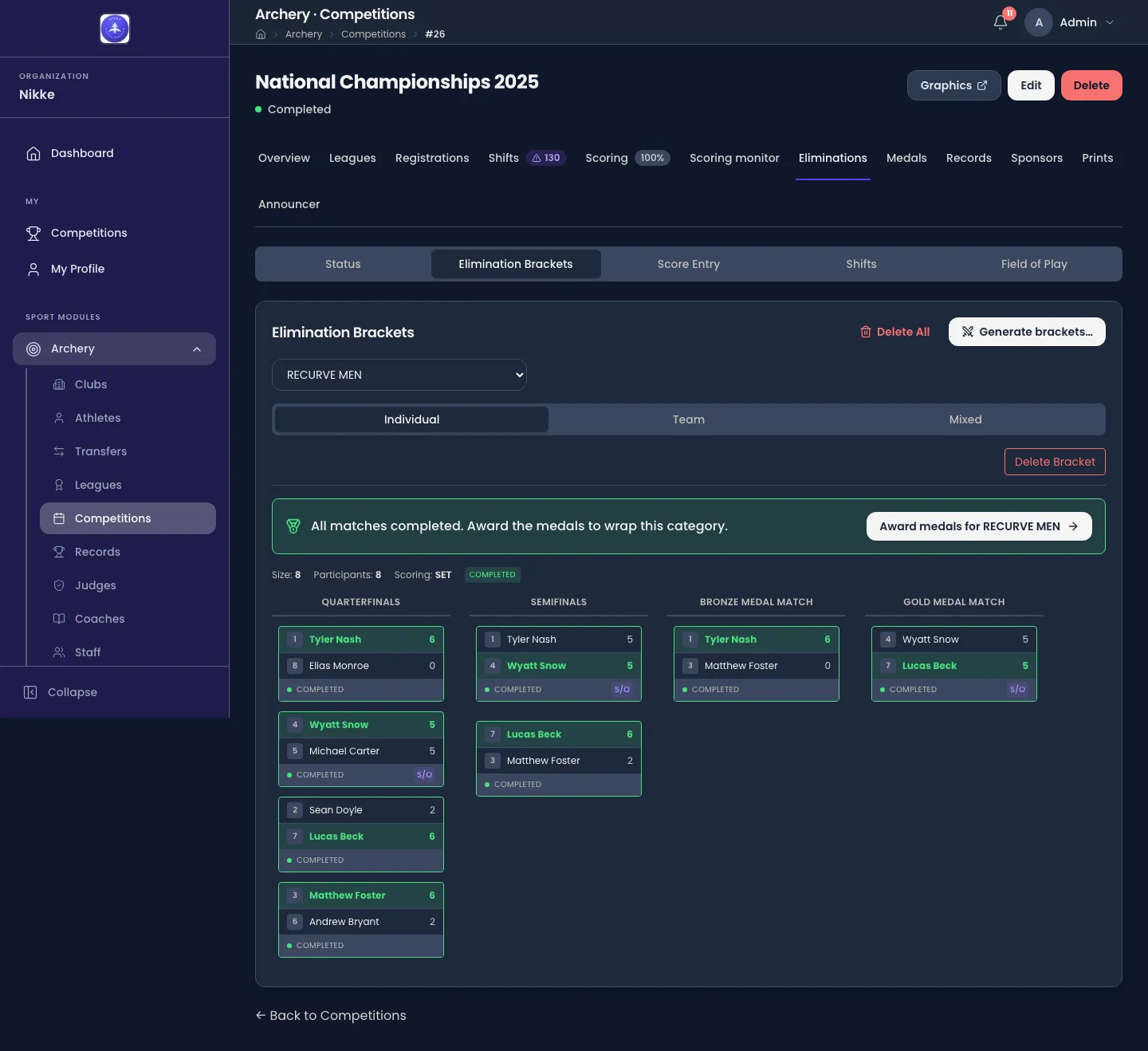
Generate brackets… does the same job across every league and event at once, which is how you would normally start a finals day. It lists what each one would draw and at what size, shows the leagues that already have a bracket but will not let you pick them, and draws only what you ticked.
Ties at the cut
Section titled “Ties at the cut”When two archers tie on total score and the tie straddles the last qualifying place, the count-back used elsewhere is not enough — World Archery §12.5.2 requires a shoot-off to settle who is in. Velos will not draw the bracket until it has that result: it lists the tied archers, you put them in the order the shoot-off finished, and generation continues. The shoot-off at the cut is described with the standings it comes out of.
Drawing it again
Section titled “Drawing it again”A bracket can be replaced while its league is still in eliminations. Delete Bracket takes that one draw away — its matches and everything scored on them — and puts the league back where it was, ready to be drawn again. It is refused while a match is actually being shot, so finish or reset that match first. Delete All, at the top of the view, does the same for every bracket on the competition.
What you cannot do is reopen the qualification underneath a bracket: the draw was seeded from those standings, so Reopen is offered only while a league has no bracket at all. Delete the bracket and it comes back, as Leagues describes.
The two scoring forms
Section titled “The two scoring forms”Which form a match uses is decided by the bow, not by you:
- Set scoring — recurve, barebow and every other bow. Each end is won, drawn or lost: 2 set points for winning it, 1 each for a draw, 0 for losing. The first archer to reach the threshold wins the match, whatever the arrow totals say.
- Cumulative scoring — compound, and only compound. Arrow scores simply add up across the match, and the higher total wins.
An individual match is 3 arrows an end, up to 5 ends, and the first to 6 set points. Team and mixed matches are longer and are won at 5; their table is on Team and mixed team events.
A set is only settled once both archers’ arrows are in. Enter one archer’s end and the totals on screen move with it, but no set points are awarded until the other archer’s arrows are there too — so a half-entered end never hands anyone a set they have not won.
A set-scored match still level after the last set goes to a shoot-off, below.
Working through the matches
Section titled “Working through the matches”Score Entry is the working screen for a finals day: every match of the chosen league and event, grouped by round, with what each one still needs.
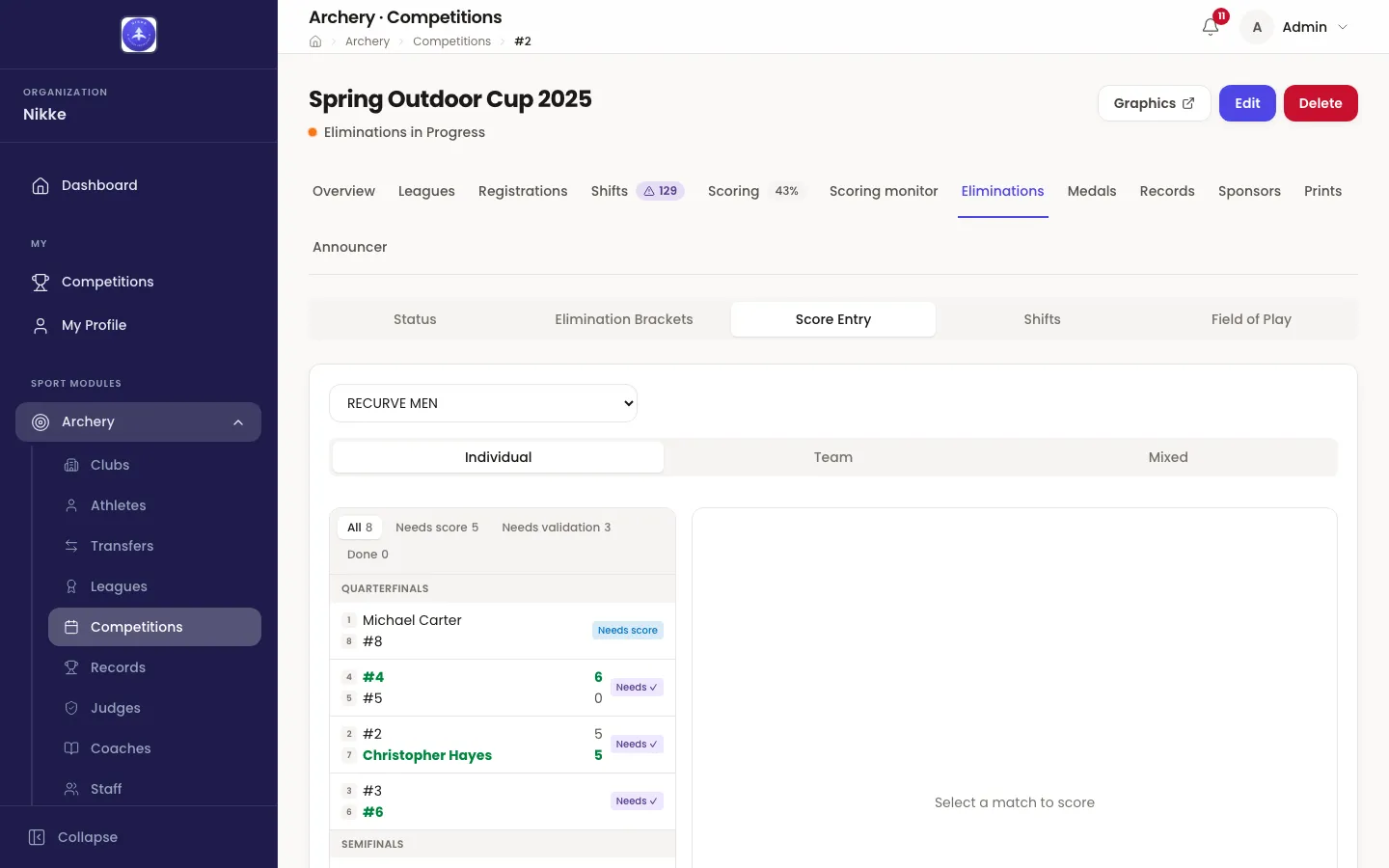
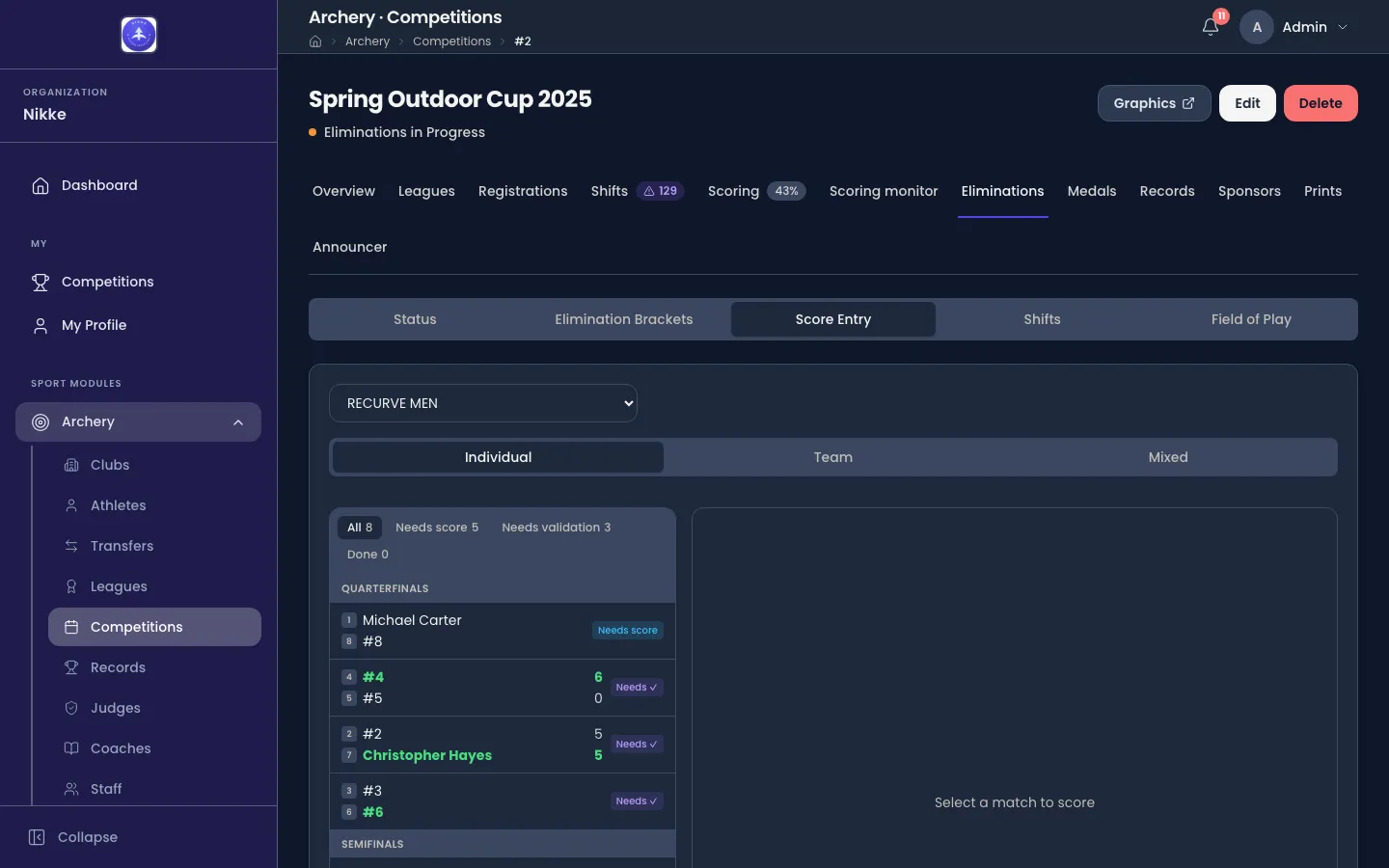
- The list is grouped by round — Round of 16, Quarterfinals, Semifinals, then Gold and Bronze.
- The small number beside each name is that archer’s qualification seeding, so you can see at a glance whether the draw is going to form.
- TBD is a place waiting on an earlier match.
- The filters across the top are the day’s work queue: Needs score is what has not been shot or entered, Needs validation is entered but not yet checked against paper, and Done is finished with. Next unscored and Next to validate jump you to the next one of each without hunting.
Scoring a match
Section titled “Scoring a match”Open a match and score it end by end.
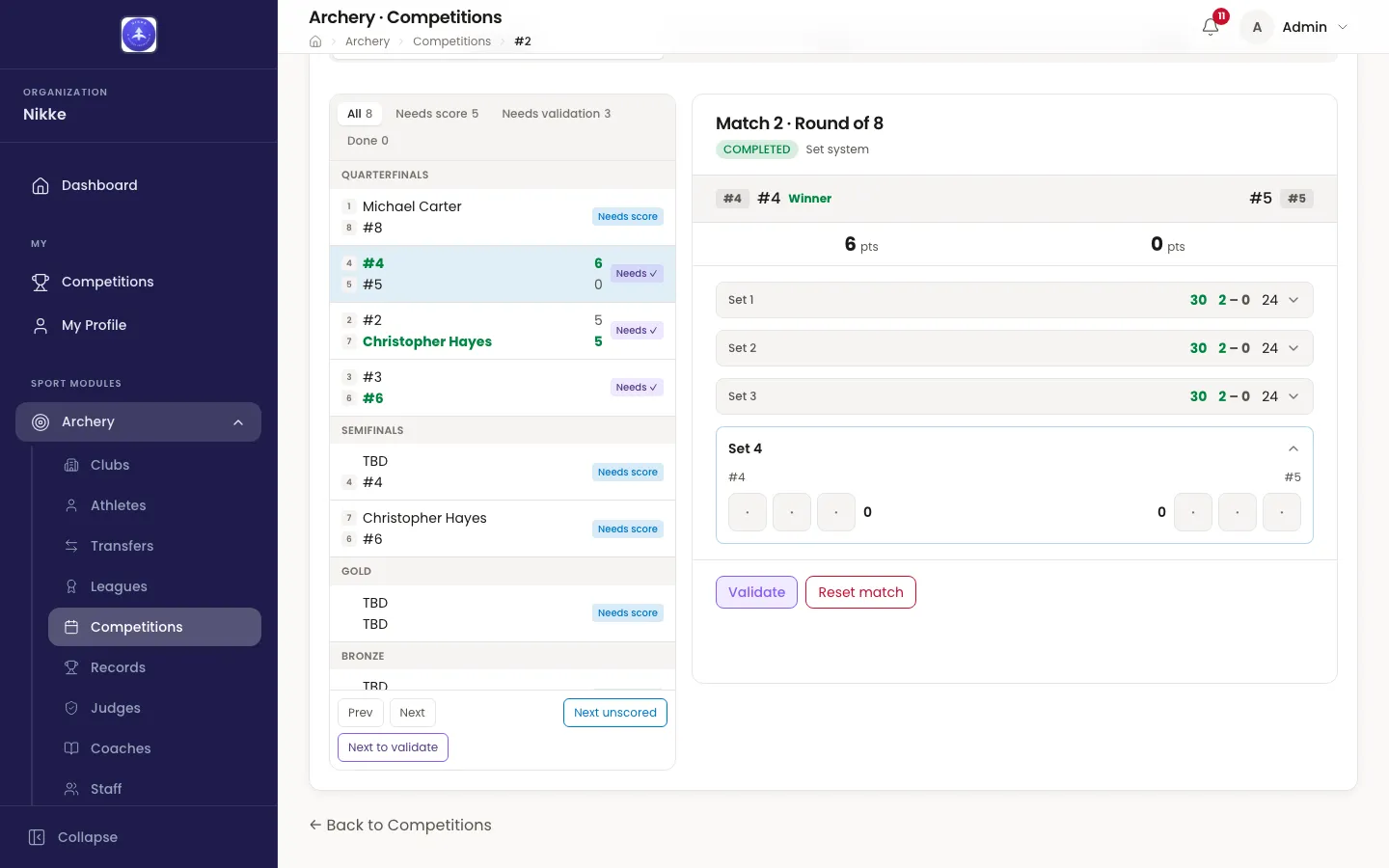
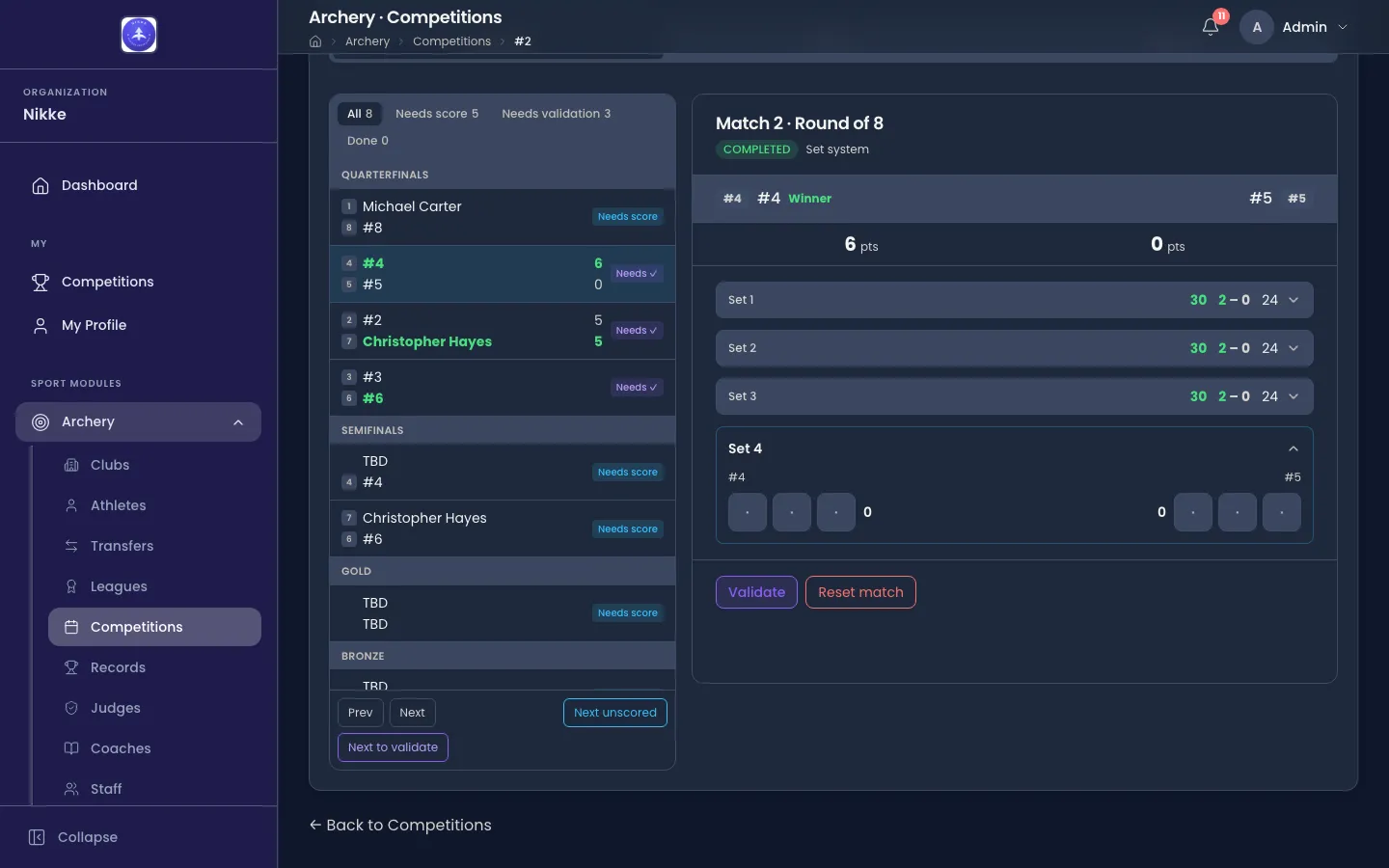
- Enter the arrows for each side of an end. Velos totals the end, awards the set points and keeps the running result; you never add anything up.
- Arrows save as you type, one archer’s end at a time, so two people can score the two archers independently.
- A match finishes on its own once one side reaches the threshold — you do not have to declare a winner.
- Reset match clears every end, shoot-off and result, pulls whoever advanced back out of the next round, and reopens it for re-scoring. It cannot be undone.
Checking against paper
Section titled “Checking against paper”At a shoot the paper scorecard is the authority, not the screen — so a result typed in on the line is not finished until somebody has held it against the card. That check is what Validate records.
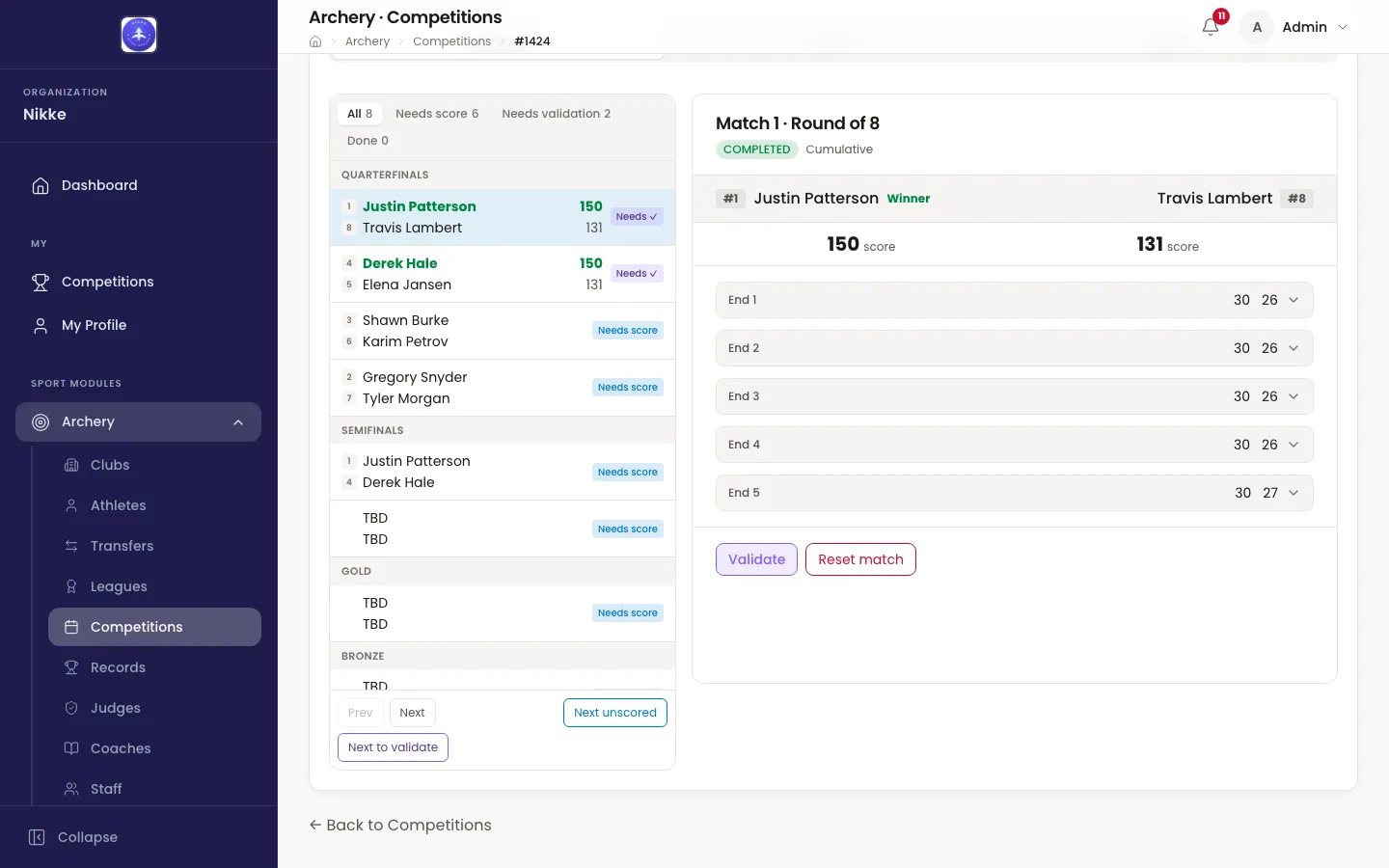
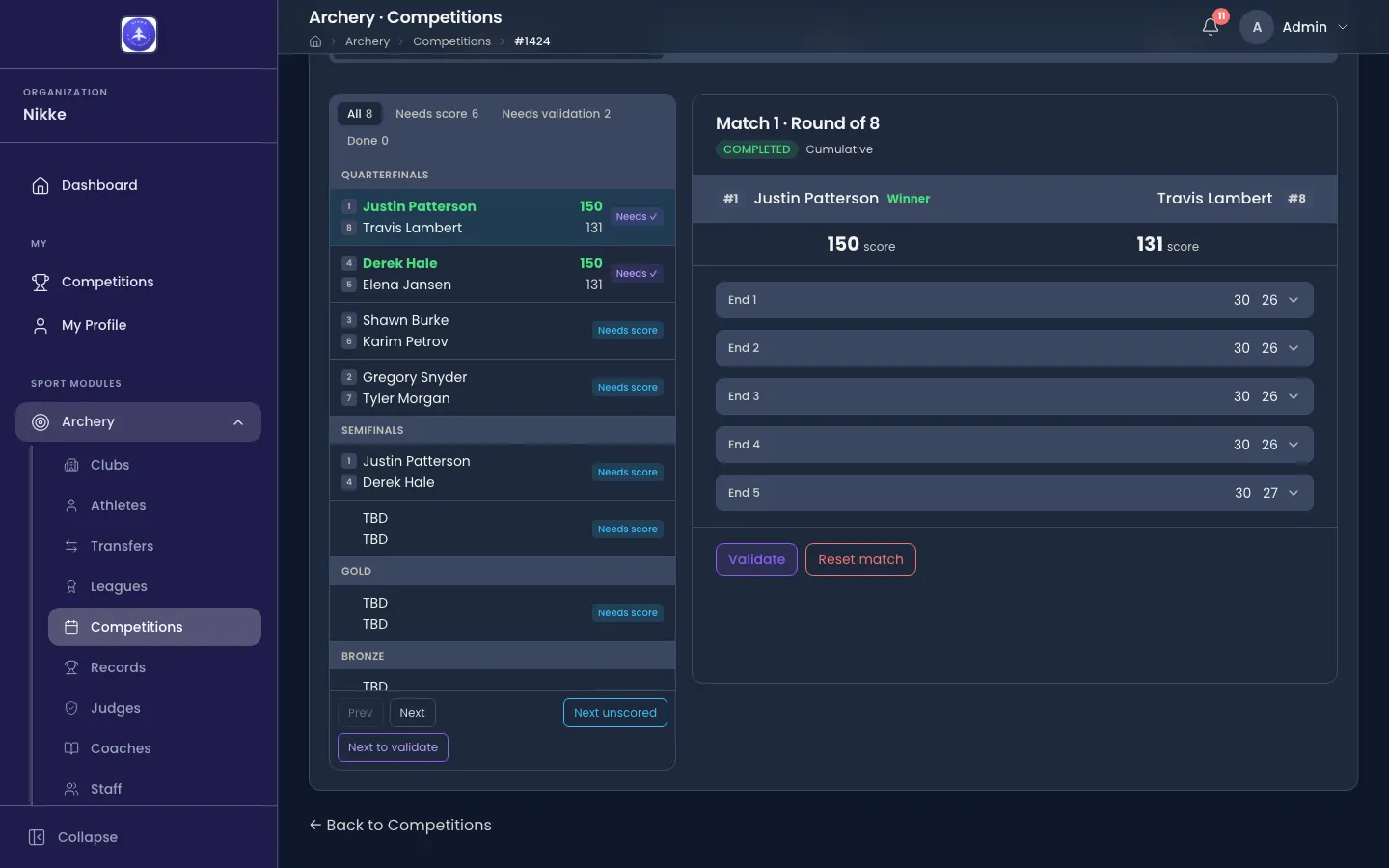
- Validate stamps the match as checked, with the date, and moves it out of the Needs validation queue into Done.
- A validated match is frozen. No more arrows, no shoot-off, no reset, no forfeit — from the web admin or from a phone at the target, since both write through the same rules. This is the point of validating: a confirmed result cannot quietly change afterwards.
- Reopen to edit lifts the lock when something turns out to be wrong. It changes nothing else — the scores, the winner and whoever advanced all stay exactly as they were — so reopening is safe on its own, and the correction is the ordinary re-scoring that follows.
- Only a finished match can be validated. One still being shot has no final result to confirm, and a bye has no scorecard at all.
- Matches scored from a phone are flagged as such, since those are the ones most worth reconciling.
This matters beyond tidiness: medals awarded from a match that has not been validated are marked Provisional until it is, as Medals and final standings describes.
Forfeits
Section titled “Forfeits”An archer who does not appear, or who cannot continue, is recorded as a forfeit — the match is settled without arrows and the other side goes through; a semifinal settled this way still sends its loser to the bronze medal match. It is recorded on a match that has not finished; one already decided has to be reset first, and one already validated has to be reopened.
Scoring from a phone at the target
Section titled “Scoring from a phone at the target”Elimination matches can be scored where they are shot, exactly as the ranking round is. The target board printed for a match carries its own QR code, and whoever scans it with the Velos app gets that one match to enter arrows into — that match, and nothing else. What is typed in lands where web entry lands, and the same rules apply either way. Qualification covers what a scan opens and how long it lasts.
Shoot-offs
Section titled “Shoot-offs”A set-scored match level on set points after the last set, or a cumulative match level on total, goes to a single shoot-off arrow each.
- The higher arrow wins.
- If the arrows tie in value, the closest to the centre wins. Enter each arrow’s distance from the centre in millimetres and Velos settles it. For team and mixed events it compares the closest arrow, then the second, then the third.
- Still tied? Record another shoot-off and shoot again.
On a set-scored match the winner of the shoot-off is given one more set point, so an individual match level at 5-5 is recorded as 6-5 (a team match’s 4-4 becomes 5-4): the scoreline says who won it and how. On a cumulative match nothing is added — the totals were level and stay level, and the shoot-off decides only who goes through.
A shoot-off can be deleted if it was recorded wrongly. If it had settled the match, the match reopens so you can record it again.
Team and mixed team events
Section titled “Team and mixed team events”Alongside its individual bracket a league can run a team bracket — three archers of one club shooting as a side — and, where it is paired with the opposite gender’s league, a mixed team bracket of one man and one woman per club. Both are drawn from the same standings, live on this same tab behind the Individual / Team / Mixed switch, and are scored by the rules above with clubs on each side instead of archers.
Who ends up in a team, how a roster is adjusted before the draw, and the longer matches they shoot are all on Team and mixed team events.
Targets and running order
Section titled “Targets and running order”A finals day of any size is also a schedule and a plan of the shooting line: elimination shifts say when each round is shot, and the field of play says which match stands on which target. Both live on this tab, in the Shifts and Field of Play views, and both — with the target addresses, the conflict warnings and the board the line is run from — are on Field of play.
The announcer’s briefing
Section titled “The announcer’s briefing”Where it is in use, an Announcer tab gives the finals announcer a per-match briefing — who the two sides are, with their photographs and club crests, how they reached this match, their record against each other, and where the match stands right now. The tab itself is the preparation view: two tiles, Sessions and Matches, and Open announcer view, which takes you into the full-screen briefing.
The briefing opens on the rundown — every match of the finals in speaking order. Hide finished drops the ones nothing more can be said about: completed matches, byes and walkovers, and any session with none left to call. The rows that remain keep their numbers, so a match is still called by the number the field crew knows it by, and the progress bar and counts still count everything. When nothing is left it says Nothing left to call, and Show finished brings them back; the choice is remembered on that browser. A Close button in the corner, there in every state, is one step back to the competition.
It is a staff surface: it is never public, and it needs its own permission on top of being switched on.
Once the medal matches are shot, the competition is down to its results. Medals and final standings covers what those matches awarded, and the finishing order behind it.
Updated for v1.63.0