
The arrow plot
A score says how well an end went. The Arrow Plot says where it went. For sessions shot with target input in the Velos mobile app — the athlete touches the spot on the target face where each arrow landed — Velos keeps every arrow’s impact and draws them back on a target on the web.
Where it appears
Section titled “Where it appears”The plot is a card on the training session itself, on both the live screen and the completed session — no separate page, no export to open first. It sits between the session’s setup and its totals.
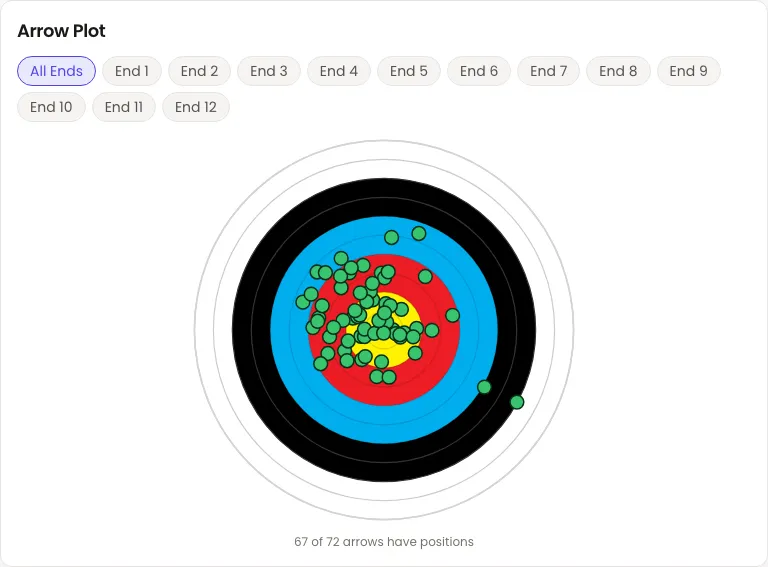
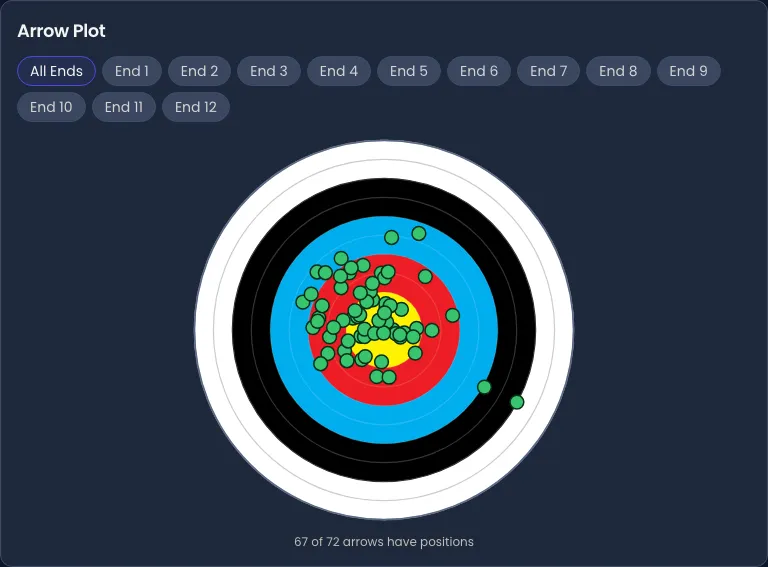
The target drawn is the session’s own face, at the ring count that face actually has: a reduced face — a 6-ring or a 1-spot — is drawn with its own rings rather than a full face with the outer ones greyed out, so an arrow sits where it sat on the real paper.
Staff are not the only readers. A club coach sees the same card when opening the session from the club portal, and the athlete sees it on their own completed session in the mobile app — the impacts they entered, drawn back at them.
The line under the target — 67 of 72 arrows have positions — is the honest one. It counts the arrows of the whole session that carry an impact against every arrow recorded, and it is not affected by which end you are looking at. Where the two numbers differ, some arrows were entered by value rather than on the target: an end typed in afterwards, an arrow chosen on the keypad, or a correction made on the web.
Reading one end at a time
Section titled “Reading one end at a time”All Ends is the whole session. The pills beside it narrow the target to a single end.
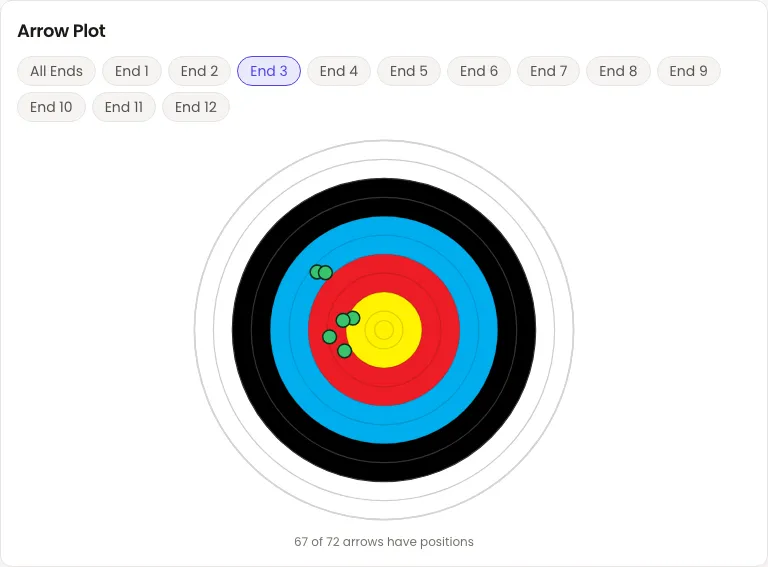
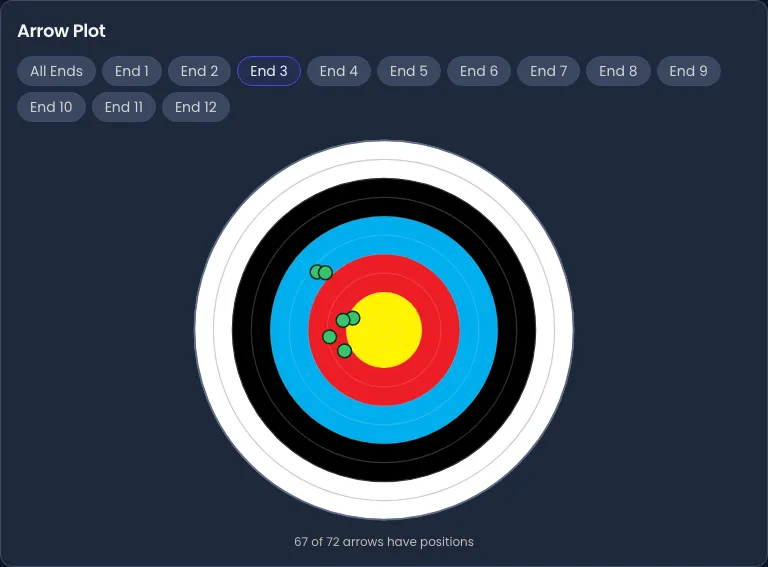
A whole session’s plot shows a tendency — a group sitting low, a drift left as the light goes. One end shows a group, which is what a coach actually talks about between ends. Only the ends that have plotted arrows get a pill, so an end typed in on the web is simply not offered.
Hovering an arrow names it — its end, which arrow of that end it was, and what it scored — which is how you find the flyer that cost an end without counting round the target.
Why a session might not have one
Section titled “Why a session might not have one”The card only appears when there are arrows to draw, so a session with no plot is not a broken page. There are two ordinary reasons:
- The session was scored on the web. Typing 9, 8, 9 into an end records three scores and no impacts. Impacts come from target input, which is a mobile app action.
- The athlete surface is not switched on. Athletes only score their own sessions in the app where your federation, club or academy has enabled it.
A session can be part-plotted, and often is — the athlete entered most of it on the target and an end was fixed afterwards. Velos plots what it has and tells you the count.
Where the impacts come from
Section titled “Where the impacts come from”Impacts are recorded once, at the line, by the athlete touching the target face in the mobile app — one touch records both the arrow’s value and where it landed — and are stored as a place on the face rather than as a picture of it. The web plot re-draws them on the same face, at the same relative place, so what a coach sees on the web is what the athlete entered on the phone.
That also means the plot is only ever as truthful as the entry. It is a record of where the athlete said each arrow landed, and it deserves the same trust as the score entered beside it — no more.
Updated for v1.63.0