
Team and mixed team events
A league does not only produce individual matches. Alongside its individual bracket it can run a team bracket — three archers of one club shooting as a side — and, where it is paired with the opposite gender’s league, a mixed team bracket of one man and one woman per club.
Both are drawn from the same qualification standings the individual bracket is drawn from. Nobody enters a team event separately, nothing extra is shot to decide who is in one, and no club has to declare a squad in advance: the ranking round decides it.
What a club team is
Section titled “What a club team is”A team is a club’s top three qualified archers in that league, in the order the qualification round left them — the club’s best-placed archer, then its second, then its third. Only archers who actually shot and were ranked are eligible, so an entry with no score is part of nobody’s team.
Clubs that cannot field three do not enter the team bracket. There is no combining two small clubs into one side, and no reaching into another league for a spare archer — with one exception, below.
Completing a short team from U21
Section titled “Completing a short team from U21”Some federations allow a club that is short of senior archers to complete its team from its own under-21 archers. Where that rule is switched on, Velos offers it as a choice at the moment teams are formed: it counts the short-but-completable clubs, lists them, and forms a filled team only for the clubs you tick. Untouched, nothing is borrowed.
Three things hold whichever way you answer:
- The U21 archers come from the club’s own U21 league of the same bow type and gender — and, where levels are in use, the same level. Not from another club, and not from the U18 or the +50 league.
- A borrowed archer never displaces a senior. Every senior the club has qualified is used first, and U21 archers only fill spots that are genuinely empty. A club with three seniors is never offered the choice at all.
- At least one senior always shoots. A team made up entirely of U21 archers is refused, however short the club is.
Borrowed archers carry a U21 tag wherever the team is shown, so a roster never hides where its third archer came from.
One set of maths
Section titled “One set of maths”Two screens tell you about teams before any match is shot: the count shown before any are formed, and the teams that forming them actually creates. Both are worked out by the same piece of Velos, from the same standings, so they cannot drift apart: a club counted as fielding a team is a club that gets one.
That matters most under the U21 rule, where “how many teams does this league have?” has two different honest answers depending on whether borrowing is allowed. Velos never answers it two different ways at once.
Forming the teams
Section titled “Forming the teams”Teams live on the Eliminations tab. Choose the league, choose Team on the Individual / Team / Mixed switch, and — while the league’s qualification is finalized and no bracket has been drawn yet — Form Teams builds them.
- Every club that can field three gets a team. You do not pick the clubs.
- At least two clubs must be able to, or there is nothing to draw a bracket from and Velos says so.
- Teams are seeded by combined qualification score — the three archers’ totals added together. A club whose three archers scored more starts higher in the draw.
- A tie on the combined score is broken by count-back, the same way individual standings are: outdoors by the combined number of Xs first, then 10s, then 9s; indoors the X count is skipped and it goes straight to 10s and 9s. A team completed under the U21 rule is seeded like any other, but it is never awarded a team medal from the standings.
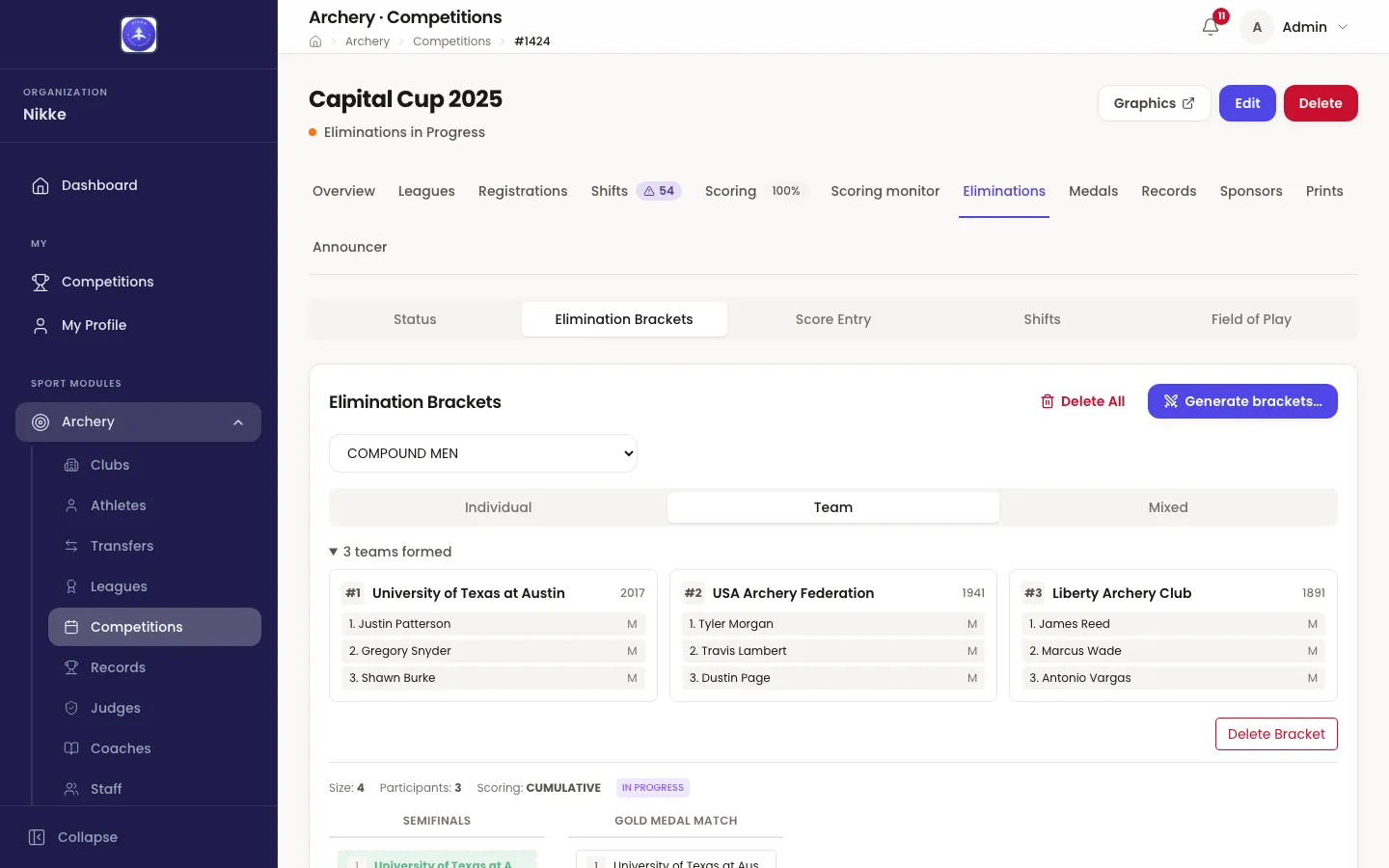
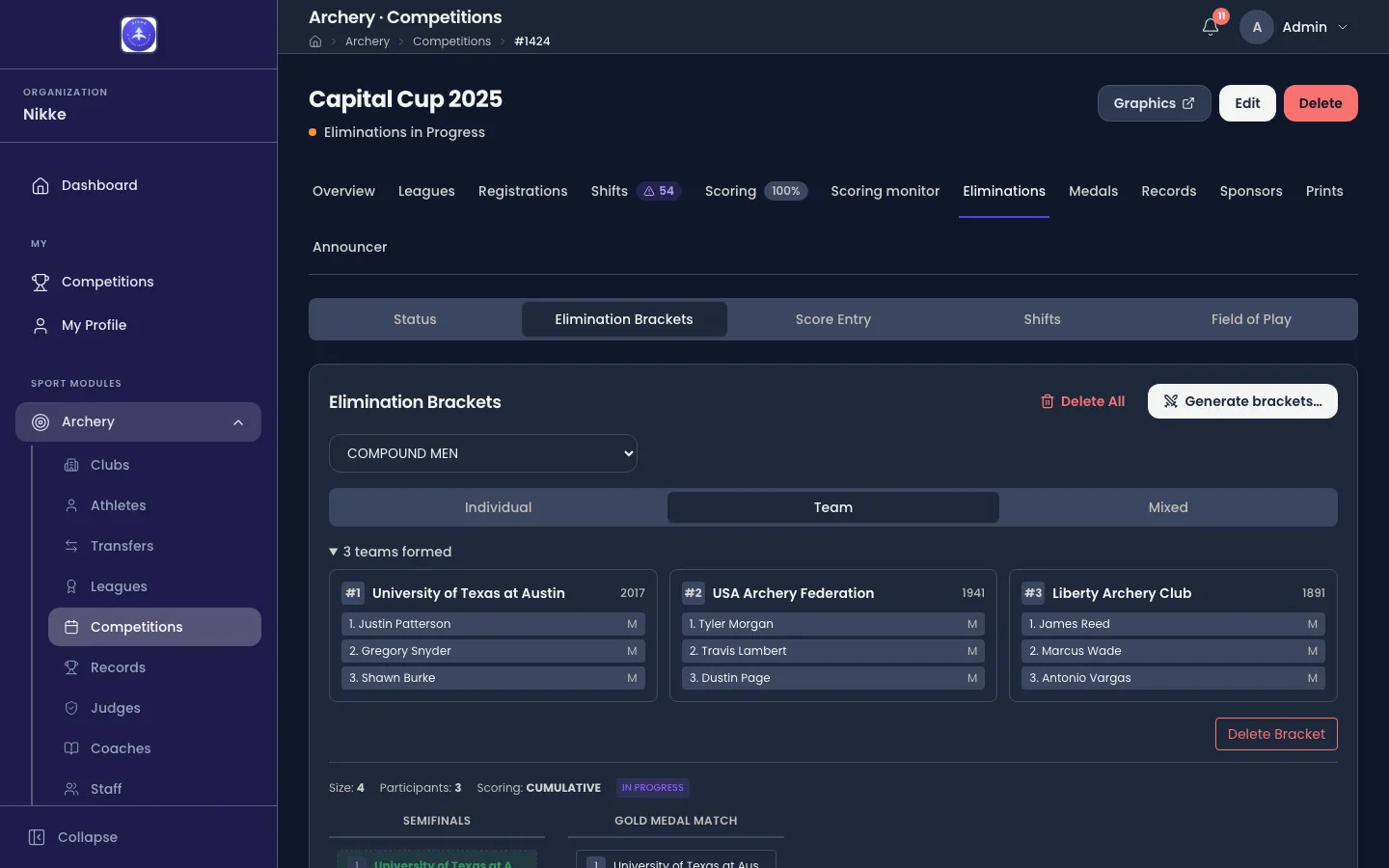
Formed teams sit in this panel for the rest of the competition. Before a bracket is drawn the panel is open with its actions; once one exists it folds into a N teams formed line above the tree, which opens on a click.
Delete Teams clears them so they can be formed again — worth knowing after a late score correction changes who a club’s top three are. It is refused once the bracket exists; delete the bracket first.
Ties at the cut
Section titled “Ties at the cut”Where a bracket takes fewer teams than the league has, a tie on the combined score can straddle the last qualifying place — some of the tied clubs in, some out. World Archery §12.5.2 does not let a count-back settle that, so Velos refuses to draw until a shoot-off has been recorded, exactly as it does for individual archers. The mechanics are the same in both cases and are described under ties at the cut.
Adjusting a roster
Section titled “Adjusting a roster”The three archers Velos picked are the three the rules pick, but a club may put a different qualified archer on the line — an injury, a captain’s call. The pencil on a team’s card opens Edit team members, one dropdown per position, and the choices in it are that club’s own qualified archers.
What the dialog will not let through:
- Nobody from another club, and nobody who did not shoot the qualification round.
- Exactly three archers for a team, two for a mixed team, and never the same archer twice.
- The U21 rule, still. Where borrowing is on, the seniors-first and at-least-one-senior rules hold for a hand-picked roster as firmly as for a formed one.
Saving recalculates that team’s combined score from whoever is now in it and marks the team Override, so a changed roster is visible rather than silent. Seeds are not redrawn: the order was settled when the teams were formed.
A roster can only be edited before the bracket is drawn. Once a draw exists the pencil is gone and Velos refuses the change — the bracket was seeded from these teams. Delete the bracket, fix the roster, draw again.
Mixed teams
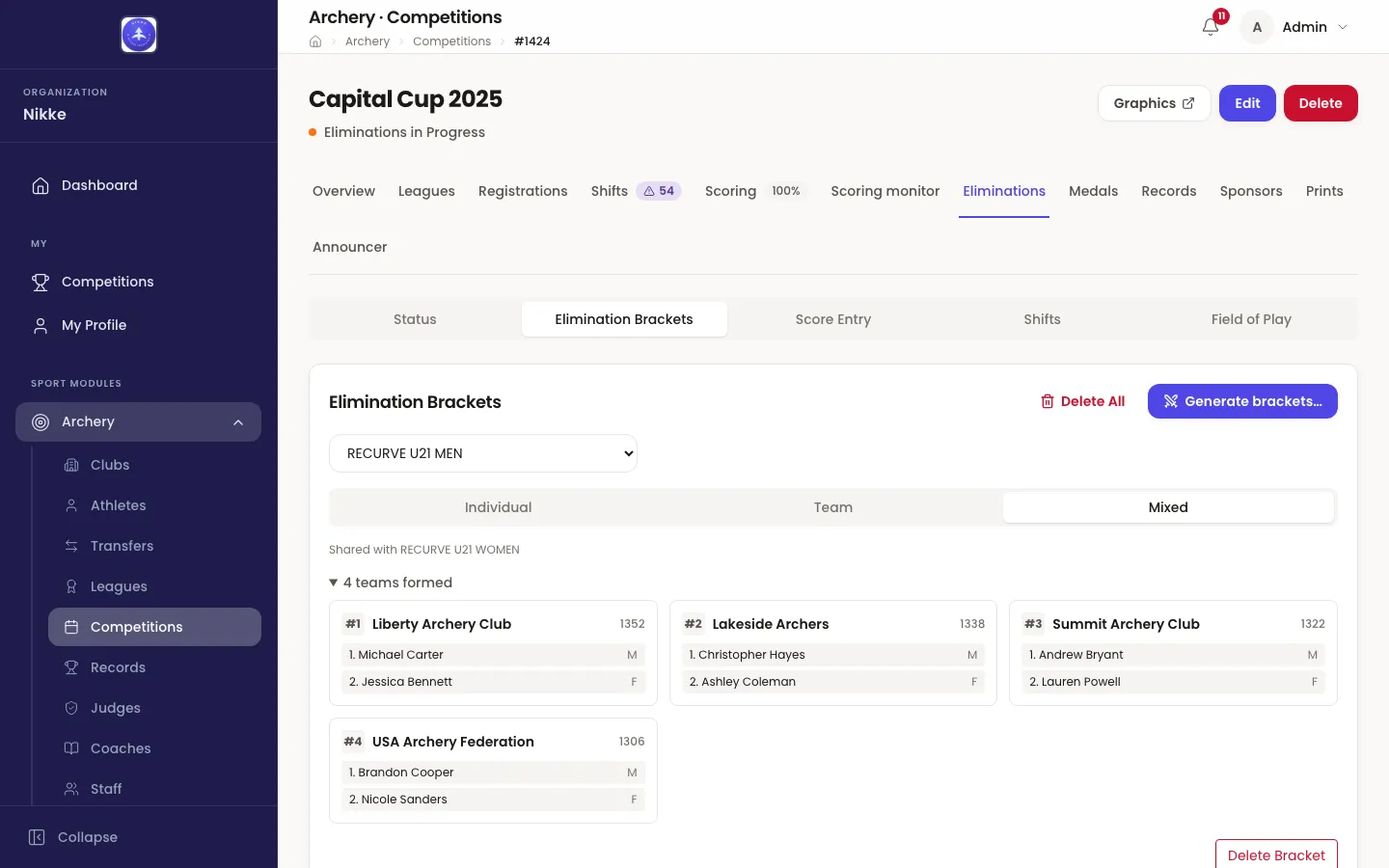
Section titled “Mixed teams”A mixed team is one club’s best man and best woman, taken from two leagues at once, and it needs those two leagues to be paired — the men’s league naming the women’s as its partner, as Leagues describes. Without the pairing there is no mixed event to form.
- Both leagues must be on the competition. A pairing that points at a league this competition does not run gives nothing to pair with.
- Both leagues have to have been shot and ranked, since each side of a mixed team is a ranked archer from its own league.
- A club with archers in only one of the two fields no mixed team. It is not an error and nothing is reported: that club simply is not in this event.
- Two clubs at least, as with team events.
Mixed teams are seeded exactly as club teams are: combined score first, then the same count-back — Xs outdoors, then 10s and 9s — for a tie.
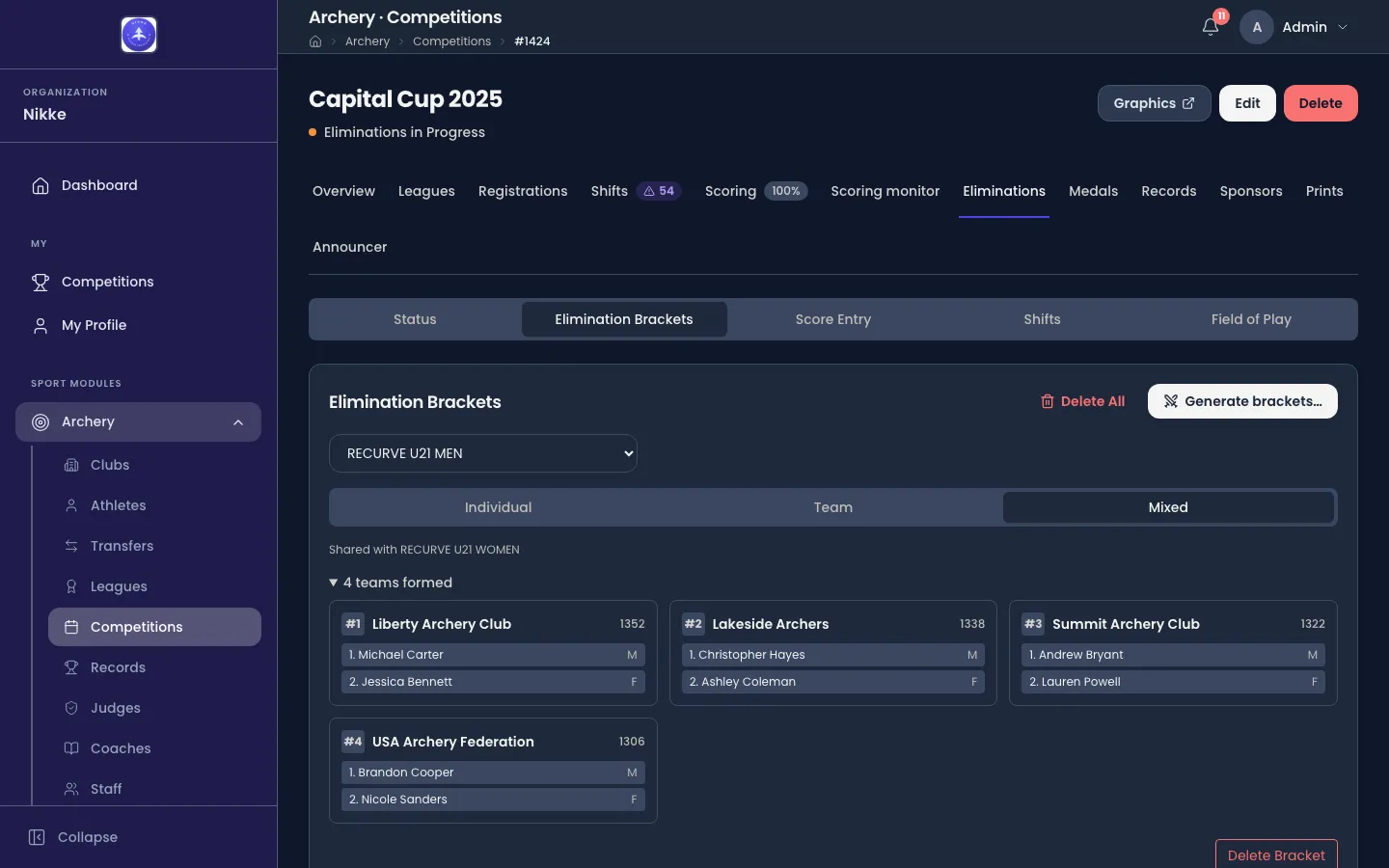
The mixed event belongs to the pair rather than to either league, so it is the same event whichever side of the pair you open it from, and a note above the panel names the partner.
The matches they shoot
Section titled “The matches they shoot”A team match is longer than an individual one, and a mixed match sits between the two. The bow decides the scoring form, exactly as it does for individuals: recurve and barebow shoot set scoring, compound adds the arrows up.
| Event | Arrows per end | Ends (max) | Set points to win |
|---|---|---|---|
| Individual | 3 | 5 | 6 |
| Team | 6 — two from each of 3 | 4 | 5 |
| Mixed team | 4 — two from each of 2 | 4 | 5 |
So a set-scored team or mixed match is won by the first side to 5 set points, which can take four ends at most; level after those, it goes to a shoot-off. A compound league shoots no sets at all — the arrows simply add up across the match and the higher total wins, which is what a bracket headed Scoring: CUMULATIVE is telling you.
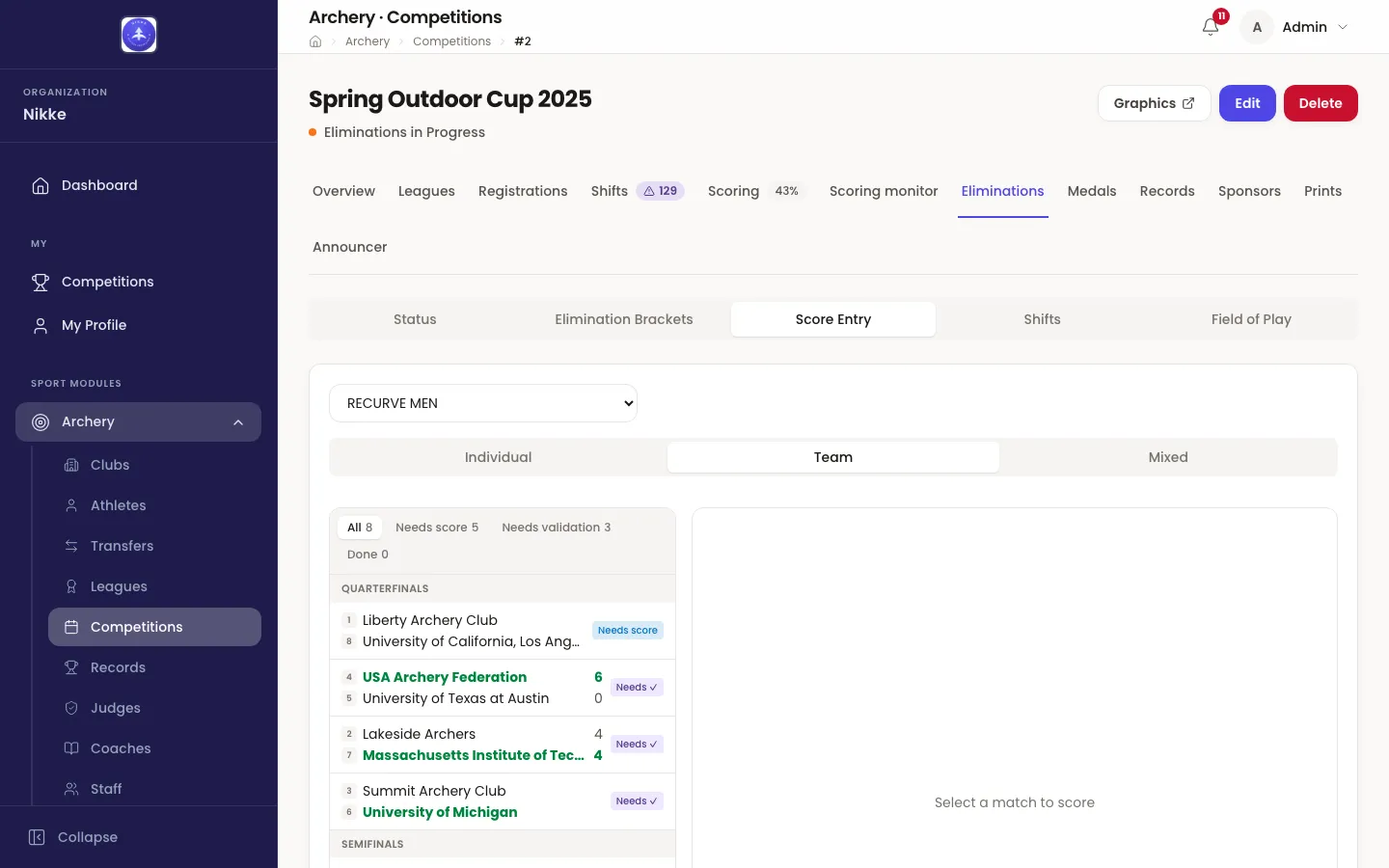
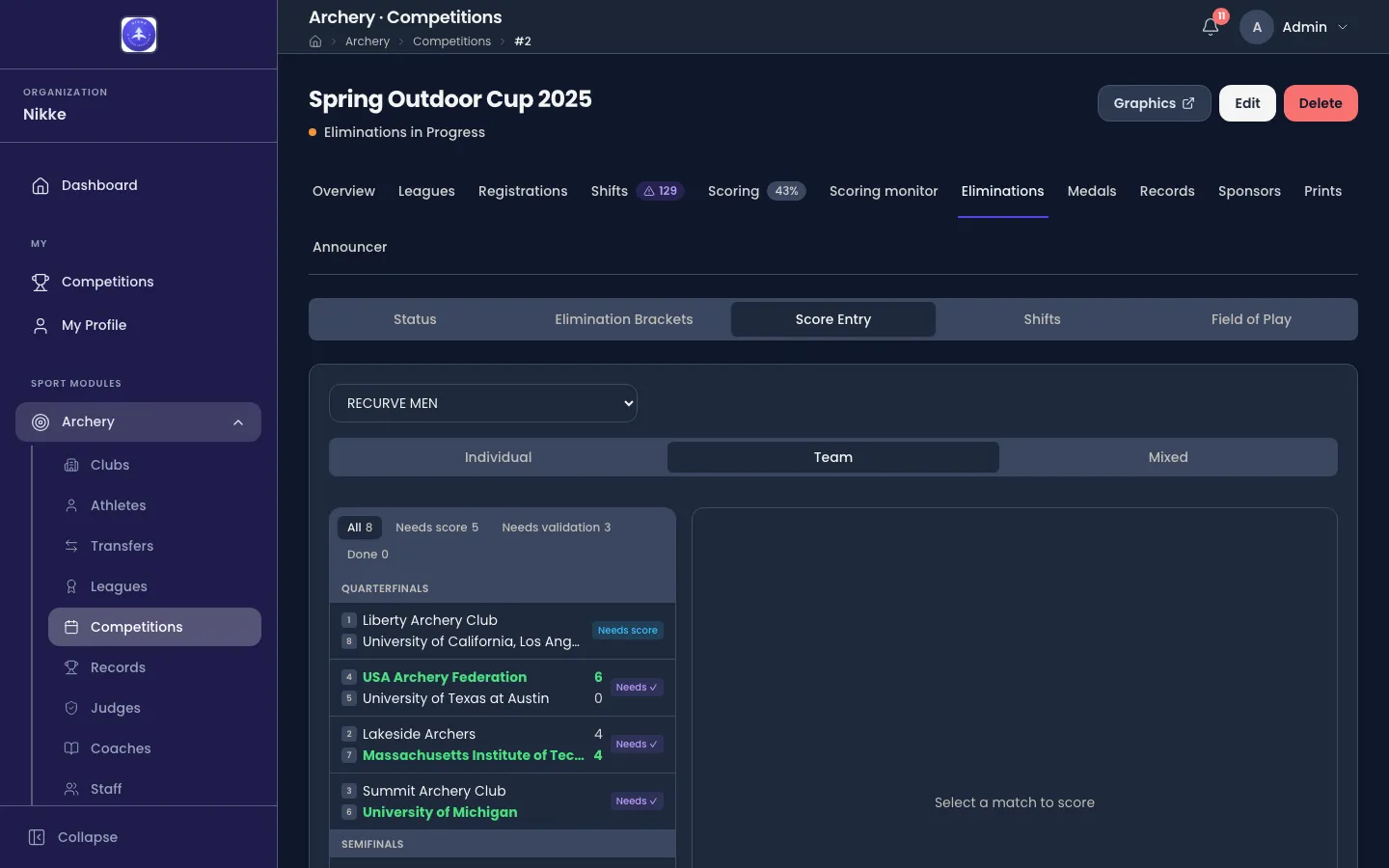
Everything else is the individual match you already know: the same worklist and its Needs score and Needs validation filters, the same end-by-end entry that saves as you type, the same checking against paper, the same forfeits, and the same scoring from a phone by scanning the target’s QR code. One difference in the shoot-off: where the closest arrow to the centre has to separate two sides and it ties, Velos compares the second arrow and then the third, because a team has more than one on the target. Eliminations covers all of it.
Where it all lives
Section titled “Where it all lives”Team and mixed brackets are drawn, read and scored beside the individual one, not apart from it. The Elimination Brackets view’s Individual / Team / Mixed switch is the whole of it: the team panel above, the tree below, and the same Score Entry, Shifts and Field of Play views serving all three.
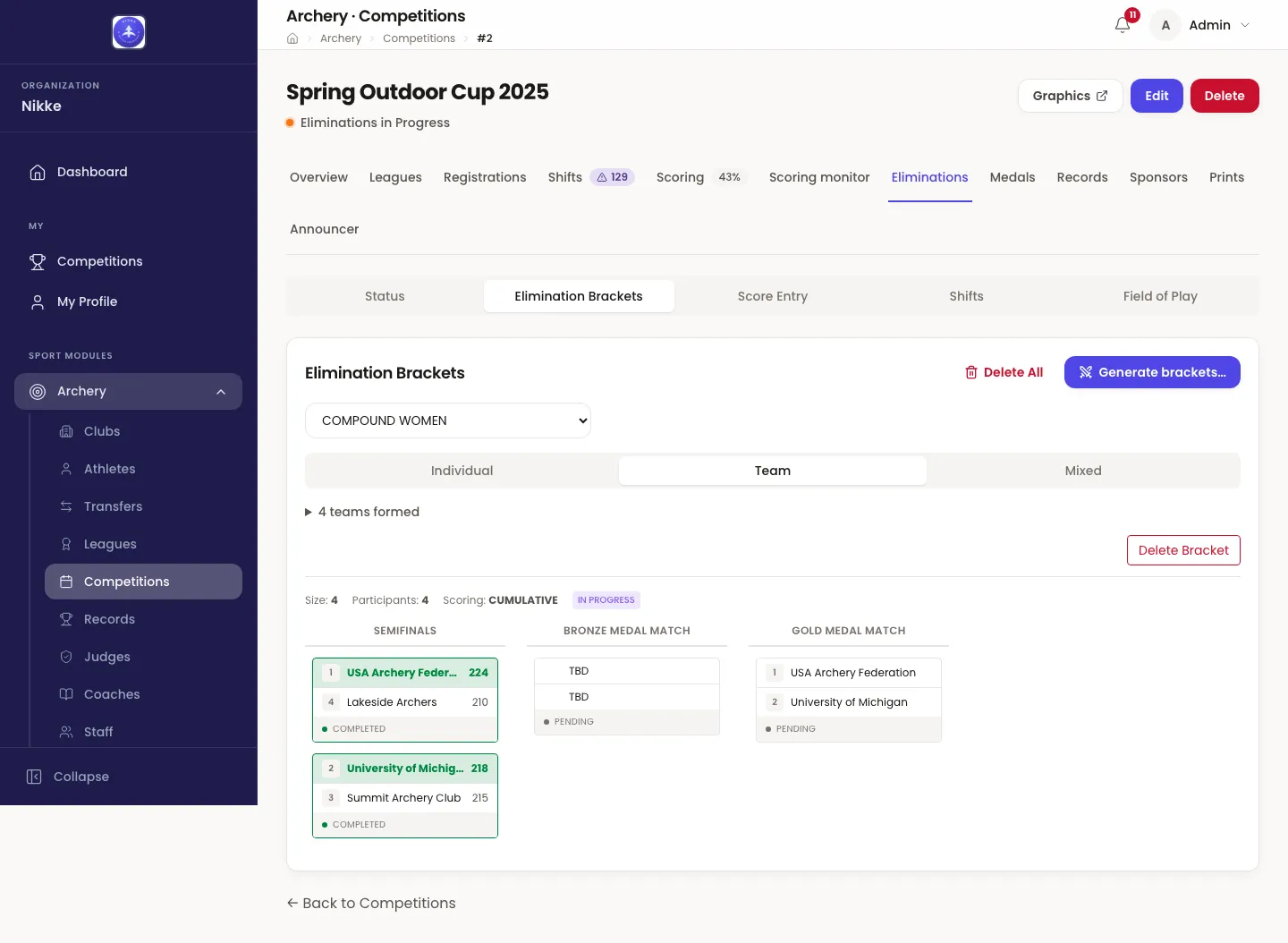
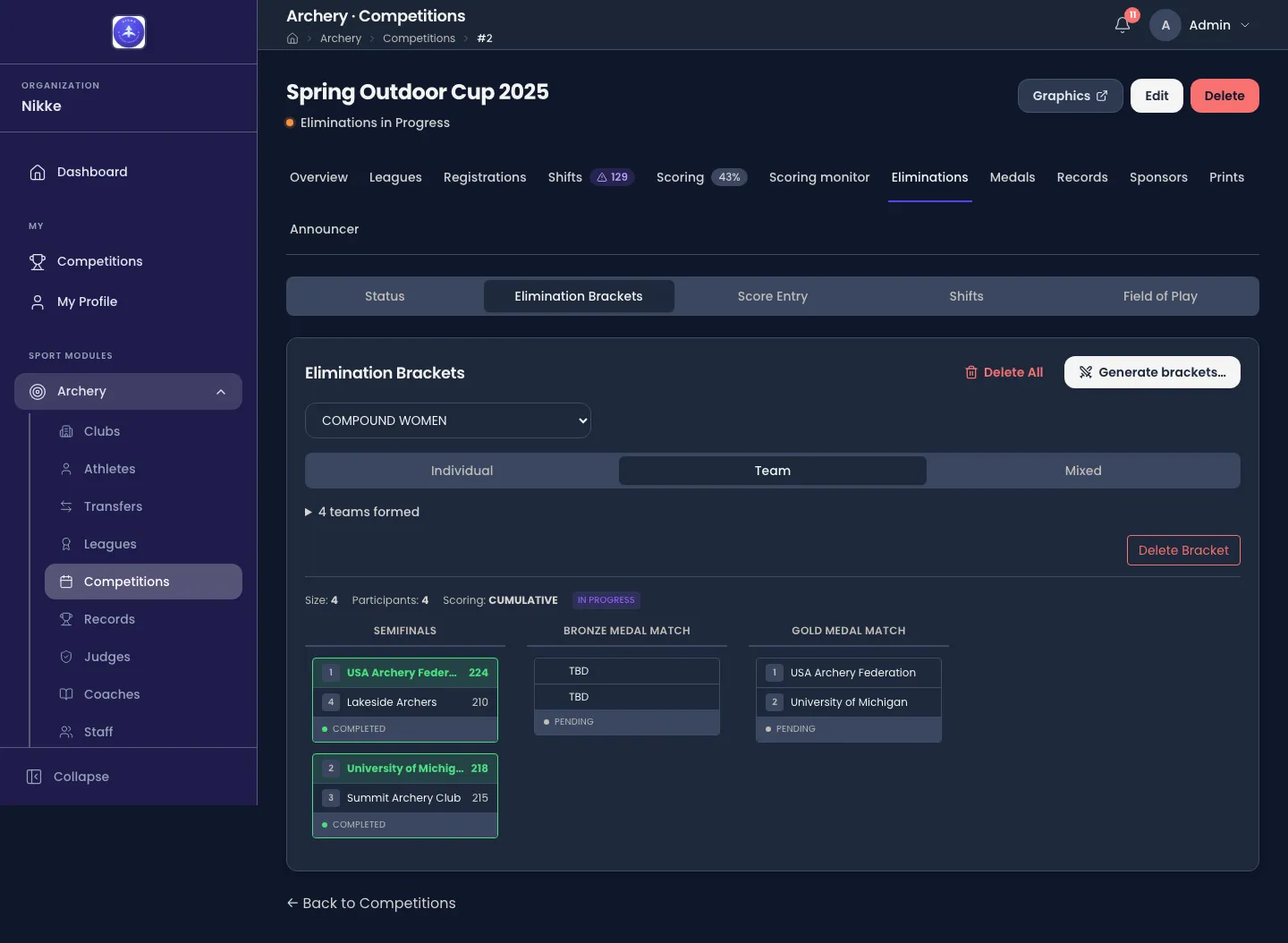
A league finishes when the last of its brackets does — individual, team and mixed alike — and each of them awards its own medals. Leagues covers that ending.
A league that ran all three events has three sets of medals to award. Medals and final standings covers awarding them, and Results and prints the paperwork that follows.
Updated for v1.63.0